Results
Challenge
Our automated underwriting engine processed thousands of credit applications daily, but it spit out a binary pass/fail screen with zero context. If you were denied, you got a cold "Application Declined" screen with a generic 1-800 number. Borrowers felt insulted by the black-box rejection, trust cratered, and support queues melted down with over 8,000 furious calls every month. Worse, federal lending regulations require explicit, legally sound adverse action notices, which our cryptic model outputs completely failed to satisfy.
Under the hood, the risk model evaluated hundreds of telemetry features, but our consumer frontend surfaced none of the attribution weights. Denied borrowers flooded Zendesk and phone queues demanding to know if a missed medical bill from 2019 or their student debt killed their loan. Frontline loan officers could only see raw risk probability buckets, so they ended up apologizing on the phone for 22 minutes per call while guessing at what the model did.
The core design challenge:
How do we turn an opaque machine learning credit denial into a clear, legally compliant explanation that teaches users how to qualify next time?
We had to balance three competing forces: strict federal compliance (FCRA adverse action codes and ECOA fair lending mandates), borrower psychology (turning rejection panic into concrete financial repair), and underwriting efficiency (giving loan officers parity tooling so they never had to second-guess the UI).
Research
We ran mixed-methods discovery across borrower cohorts and underwriting desks because we needed explanations that actually teach, not just legal disclaimers that cover our backs.
We combined historical call logs, remote borrower testing, live underwriter shadowing, and regulatory working sessions to figure out why people were dropping off and what information actually restored their confidence.
1. Numbers to narrative
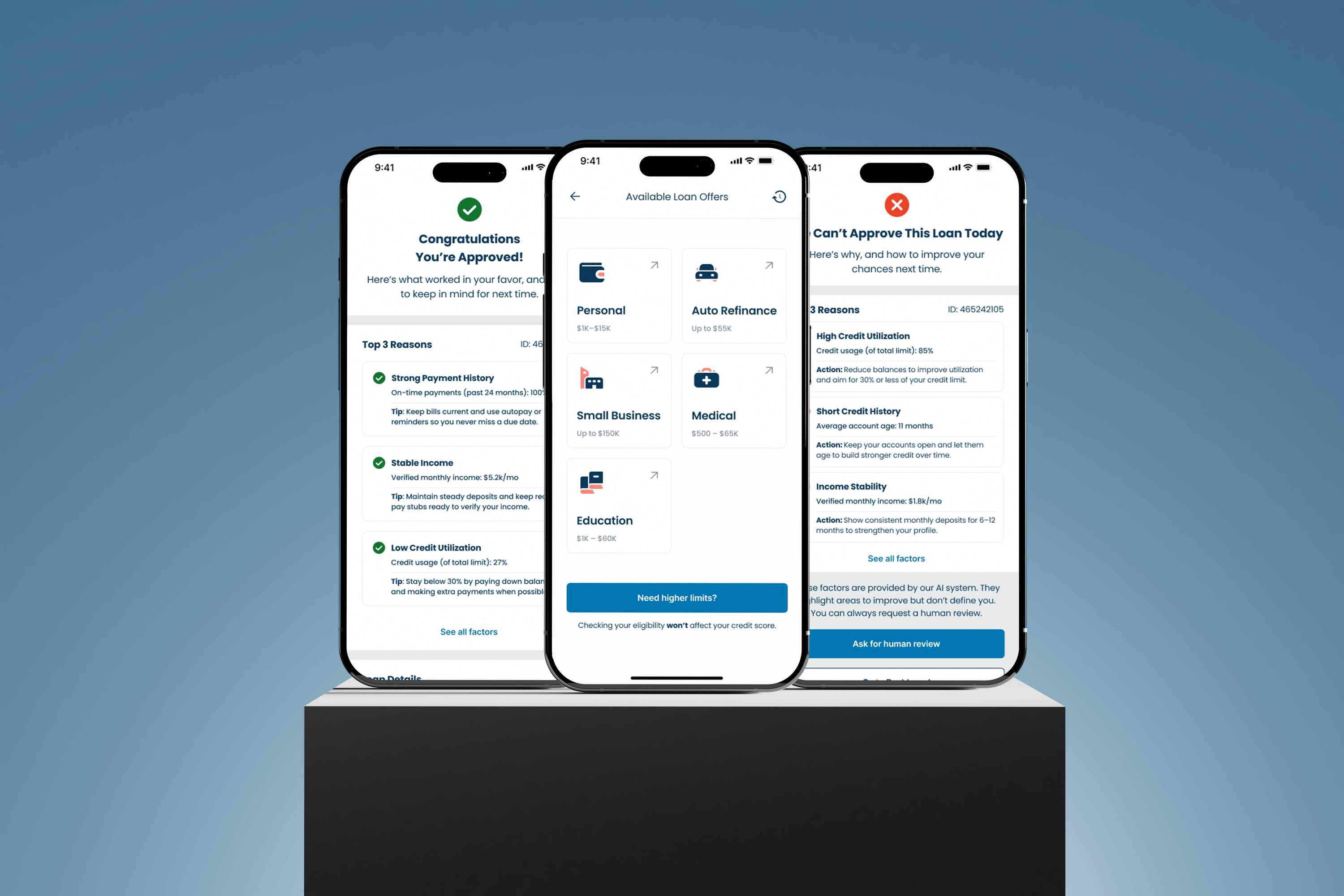
In V0, we showed raw percentages (e.g. "DTI: 44.2%"). Users panicked and argued over decimals. We flipped the hierarchy: lead with plain English insight, follow with the benchmark metric, and close with the fix.
Refined metric displays to lead with plain conversational summaries, following with supporting numerical benchmarks for users seeking deeper detail.

2. Reduced cognitive load
V1 dumped all 6 model factors on screen simultaneously, overwhelming borrowers with negative news. In V2, we restricted the primary card to the top 3 drivers, placing remaining factors in an expandable "See all details" drawer.
Implemented progressive disclosure patterns to prevent information overload while preserving full transparency for motivated borrowers.
3. Better review path
Support ops initially feared that an above-the-fold review button would flood queues. Testing proved the opposite: knowing an appeal was accessible defused panic and routed users to async ticket workflows instead of frantic live chats.
Testing proved that surfacing manual review upfront gave borrowers a sense of dignity without increasing call center volume, routing requests directly to the dedicated appeals queue.
4. Reason codes
We mapped UI explanation cards directly to backend statutory adverse action code sets so mobile screens, CRM dashboards, and mailed legal notices stayed 100% aligned.
Aligned user interface copy directly with statutory adverse action notice code registries to ensure complete consistency across digital screens, mailed notices, and CRM records.
Impact
We tracked real user behavior through the entire lending funnel during a 12-week national pilot of 50,000 applicants. At the top of the funnel, we monitored offer clicks and application completion rates to verify that upfront soft-pull clarity was removing drop-off friction.
At the decision stage, the true signal was inbound support contacts asking "Why was I denied?". Clear explanations caused those calls to plunge by 32%. We also tracked how many denied applicants returned within 90 days and cleared underwriting: second-chance approvals jumped by 57%, proving that our debt-to-income and utilization coaching was actually moving the needle.
For internal operations, we measured underwriter escalation handle times. Because customers and loan officers finally shared the exact same factor tree, officers stopped spending 20 minutes deciphering model scores, saving over 3,000 operational hours across the pilot.
Evaluated pilot outcomes across 50,000 loan applicants over 12 weeks, measuring application completion velocity, inbound support ticket reduction, second-chance reapplication approvals, and loan officer escalation handle times.
Analysis revealed that reducing underwriter escalation handle time from 22 minutes to 13 minutes per case saved over 3,000 operational hours during the 12-week pilot, while converting 57% more denied borrowers upon reapplication.
Leadership & Expertise
Leadership
Product leadership
Spearheaded the design engineering roadmap for lending transparency, aligned executives and legal counsel, and rallied teams around working prototypes.
Guided cross-functional executives to embrace transparent explainability as a competitive differentiator rather than a regulatory compliance burden.
Cross‑org influence
Partnered with Support, Risk, and Legal to ship a unified explainability playbook and synchronized denial messaging.
Unified operational policies across disparate departments to establish consistent customer-facing communication standards for automated credit decisions.
Coaching & mentorship
Mentored mid-level designers in design system architecture, state machines, and regulatory content design.
Conducted weekly craft critiques and structured coaching sessions to build organizational capability in algorithmic transparency and ethical AI UX.
Expertise
System design
Engineered a centralized reason code dictionary and tokenized XAI components that now power all lending products.
Built scalable design system components and token-driven explanation cards deployed across web and native mobile lending experiences.
UX & interaction
Architected end-to-end flows from pre-qualification soft pulls to adverse action reports with progressive detail-on-demand.
Engineered intuitive interaction patterns that balance immediate scannability with comprehensive audit detail for advanced users.
Visual craft
Built high-contrast, accessible visual hierarchy with restrained motion and pixel-aligned layout metrics.
Crafted accessible data displays adhering to strict contrast ratios and screen-reader accessibility standards across dark and light themes.
Business literacy
Defined core telemetry with PM and Ops leads, directly tying clarity metrics to operational ROI and support savings.
Modeled financial returns linking reduced customer call handle times and higher reapplication conversion rates directly to design improvements.
Domain expertise
Synthesized complex financial regulations (FCRA, ECOA) and ML feature attributions into reusable design patterns.
Synthesized complex financial regulatory frameworks into actionable design heuristics that ensure long-term legal and ethical compliance.
Interested in building transparent, high-trust financial systems?
Let's collaborate on high-stakes fintech, AI interfaces, and complex design systems. Reach out directly or explore my other case studies.
Available for design engineering leadership, Explainable AI architecture, and complex design systems consulting across fintech, healthtech, and AI-driven platforms.